From the cloth merchant of Vitré to the treasurer general of Brittany: how Pierre Landais acquired Briord in 1469, fortified it, and ended hanged on the meadow of La Biesse in 1485.
From Briord to the Parliament of Brittany
If we are to understand why the Land of Briord is what it is — with its deep moats, its antiquity, its status as a châtellenie — we must go back to Pierre Landais, the great figure who, in the heart of the fifteenth century, acquired the estate, fortified it, and made of Briord a stronghold and a place of consequence in the Pays de Retz. His name is not among those remembered by the grand history of France, but in Brittany, at Nantes, in the courts of the duchy, he was for twenty-five years one of the most powerful men in the province.
Pierre Landais was born around 1430 at Vitré, an important merchant town of Upper Brittany. His origins were modest but not as humble as has sometimes been supposed. His father Jamet Landais was a cloth merchant, owner of several houses in Vitré itself and probably also at Availles. When he died around 1450, he left his trading house to his son. The young Pierre began his career serving the Count of Étampes as keeper of the wardrobe — a modest but trusted household office, since he was responsible for his master's clothes and personal effects.
Keeper of the duke's wardrobe
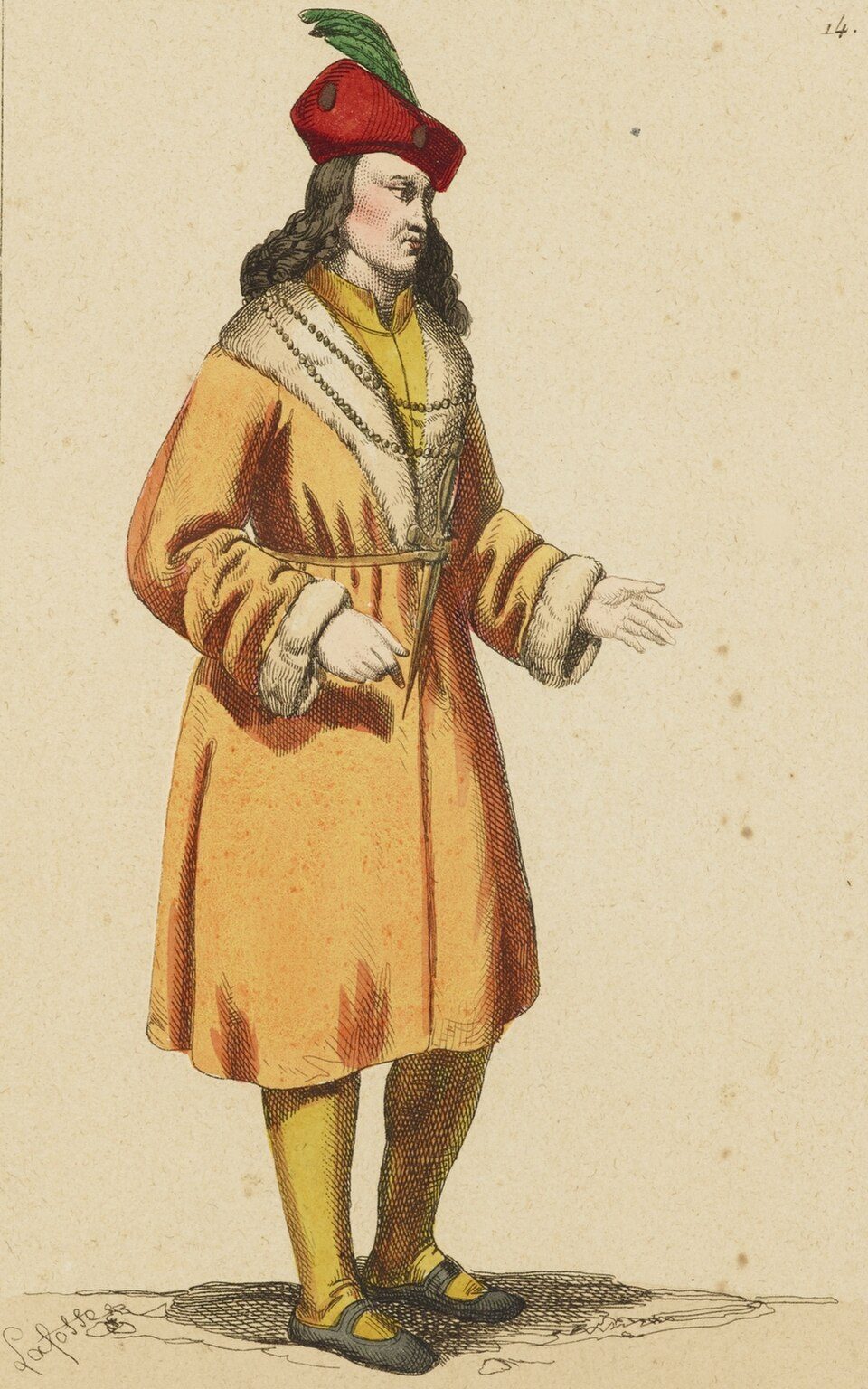
When the Count of Étampes became Duke of Brittany in 1458 under the name of Francis II, Pierre Landais kept his office. The duke was young, extravagant and pleasure-loving; his wardrobe-keeper, by contrast, was shrewd, ambitious and wealthy. Landais made numerous advances to the sovereign, proof of the sound management of his own affairs. His reward: in 1460, at around thirty, he obtained "the supreme office of treasurer general" of the duchy, which he would hold for a quarter of a century.
His annual wages — 200 livres for the wardrobe, 500 livres for the Treasury — were rounded out by the temporary exercise of several other fiscal offices: general receipt of the hearth-tax, ordinary receipt of Rennes, treasury of wars. But beyond these official gains, Landais methodically wove a network of connections that secured him loyalties and support within the ducal administration. The duchy became his domain — and, his enemies would say, his prey.
A policy of independence
Having become especially powerful in a duchy whose sovereign was readily charged with weakness, Pierre Landais could pursue an energetic policy as he saw fit. His line was clear: "to free Brittany entirely from the ever more pressing tutelage of the Kingdom of France", and to open it to the great Western trade. He supported Loire shipbuilding, protected the merchants, and developed the sea convoys that escorted the vessels carrying Bordeaux wines and Guérande salt to England and Flanders.
But this policy of emancipation clashed head-on with the chancellor Guillaume Chauvin, a man of old nobility with more Francophile sentiments. Between the two men the rivalry was as much ideological as personal: Chauvin meant to defend at all costs his place as the duke's first councillor. The confrontation lasted years. In 1481, Landais secured the chancellor's arrest; Chauvin died in prison three years later, in wretched conditions.
The seigneury of Briord
Alongside his political career, Landais continued to practise banking and trade. His list of landed property is impressive: three houses in the Rachapt suburb (Vitré) and another on the Rue Baudrairie (Vitré), the wardrobe town-house on the Rue Saint-Yves in Rennes, the Briord town-house in Nantes and the manor of La Papotière at Doulon. In the seneschalsy of Nantes, the fiefs of Les Ponts, La Sauzaie and Trentemoult. At the edges of the town: the châtellenie of Briord at Port-Saint-Père, the island of Groye in the Loire, lands at Le Plessis-Grimaud, Lucinière, La Jaguère in Rezé, and the seigneury of Le Loroux-Bottereau — "an ancient châtellenie of great revenue", endowed by the duke with three new annual fairs in 1478.
As for Briord, the chronology is precise. In February 1469, Jeanne Mauffras, widow of Jean Labbé (chamberlain of Duke Francis I and grand master of the artillery, who had acquired Briord around 1444), ceded the seigneury to Pierre Landais. On 5 December 1469, Landais paid homage for it to the duke. It is unquestionably this act that would establish the feudal power of Briord: for Landais at once obtained from the duke — who refused him nothing — the right to fortify his "house and manor" with "drawbridge and defensible moats". The homage of 1478 clearly mentions that Landais had already had the house of Briord "moated, enclosed and fortified, by way of moats and ditches", "situated in march country and next to the frontier" of Poitou.
The homage also details the revenues of this châtellenie: 133 livres of annual yield from the cens, from the working of 120 journaux of woodland, from meadows, ponds and feudal dues, to which was added the produce of 300 hommées of vineyard, the six métairies and the fisheries. It further invited his master to come and hunt there in all seasons the "red, fallow and black beasts with which the land is well stocked". One senses in Landais an ulterior motive: to make of Briord, set apart from Nantes yet close by, a possible refuge in case of disgrace.
The Briord town-house in Nantes
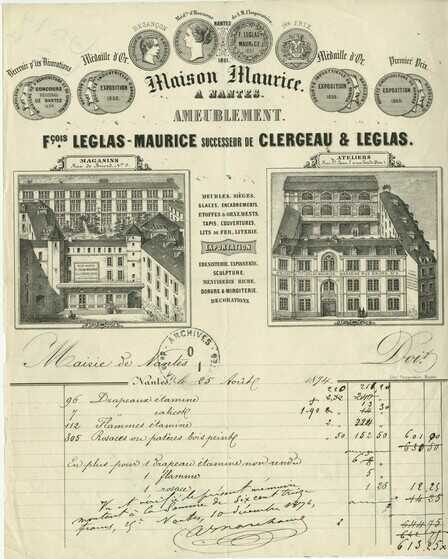
Alongside the rural châtellenie, Landais owned in Nantes itself a town-house that he acquired in 1473 from the Abbey of Villeneuve, and which would likewise bear the name of Briord: it is this house that gave its name to the street (the present-day Rue de Briord).
Situated at number 9, the town-house offered a four-storey front dwelling, a vast porch giving access to an inner courtyard, a three-storey rear dwelling, and — to the north — a large timber-roofed hall serving as the Treasury. Landais had his arms carved in stone: "gules, three cutlasses or daggers argent in pale". An inscription, noted later, reads: "Hôtel de Briord. Pierre Landais, treasurer of Francis II, had this house built. 1477."
The town-house was later confiscated by the Duke of Mercœur, inhabited by his widow, then converted to house the Jesuit fathers for a century (1669-1762); the first scientific astronomical observations in Nantes were made there. Later a saddlery workshop, then the workshop of the tapestry-maker Leglas-Maurice, and finally an annexe of the Decré stores, the building — now much altered — has returned to residential use.
La Biesse
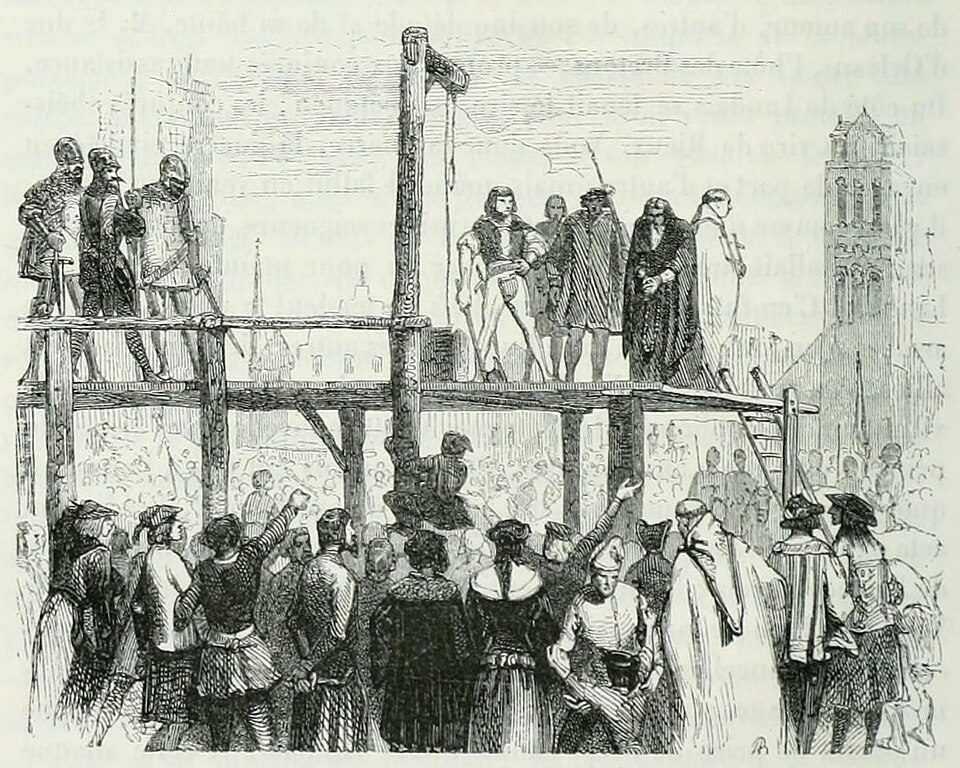
But at Nantes, fortune turned. In 1484, Landais narrowly escaped a first ambush by the Breton lords. The following year, he was arrested in the duke's very chamber, despite the latter's protests, at the end of a particularly well-organised aristocratic plot. The mock trial that followed ended in a sentence of death.
On 19 July 1485, Pierre Landais was hanged on the meadow of La Biesse at Nantes. He was about fifty-five.
Posterity was long cruel to Pierre Landais. His modest origins, his recent ennoblement (he had been ennobled in 1460 at the same time as being named treasurer general), his upstart arrogance, and the hold he exercised over the duke exasperated his contemporaries. He was made a tyrant, a greedy schemer, the man responsible for all the ills of the end of Francis II's reign. The objective reassessment by the historian Jean-Pierre Leguay now allows the debate to be freed of passion and the treasurer general to be seen in a light much closer to reality: a technocrat before his time, effective and ambitious, certainly, but no worse than other servants of the State in that century.
The descendants
On Pierre Landais's death, his property passed for the most part to his only daughter, Françoise Landais, whom he had had by Jeanne de Moussy. Françoise married Arthur L'Épervier, lord of La Bouvardière, grand huntsman of Brittany. Their son François L'Épervier, captain of Nantes, married Anne de Gouyon-Matignon (died 1515); a widower, he entered in 1516 the Order of Preachers (Dominicans), of which he became prior at the Nantes convent, and died in 1555.
From François L'Épervier was born a daughter, Bonaventure L'Épervier, who married François de La Noue, lord of La Noue and Chavannes, baron of Sançay. From this union was born the famous Huguenot captain La Noue "Bras-de-fer" (Iron Arm) — companion-in-arms of Henry IV, author of treatises on the military art, whom Henry IV would call "a great man of war and a greater man of good". His mother paid homage for the seigneury in 1533, then quickly disposed of it in favour of Jean des Rouxières, who paid homage for it to the king in 1567.
The direct descendants of Pierre Landais, far from being cast out of Breton high society, thus took their revenge through collateral kinship: the Guibé and Hamon du Bouvet families, allied to the Landais, accumulated at the start of the sixteenth century bishoprics (Tréguier, Rennes, Nantes, Saint-Pol-de-Léon, Dol, Vannes), court offices and military commands.
From his own sister, Olive Landais, married to Adenet Guibé, descended no fewer than three brother-bishops, one of them a cardinal.
The Landais manor at Briord
Of the building that Pierre Landais had constructed or fortified at Briord, little or nothing has come down to us — except the moats. A careful study of the inventories and homages allows us to imagine a quadrilateral surrounded by running moats, on the exact site of the present château: a rear-courtyard dwelling with mullioned windows, ogee-arched doorways, tall dormers with gables adorned with finials, stair-turret(s) with cut sides and candle-snuffer roofs; two wings of outbuildings set at right angles (stables, lodgings, service rooms); a wall with gate and drawbridge. There was also a "little chapel of the court", attested in a document of 1793, whose exact location is unknown.
The dwelling of Briord disappeared from the centre of what became the courtyard of honour, after Joseph Charette had it rebuilt in 1770 in the form of the magnificent neo-classical château we know today. A large part of Landais's original outbuildings survived until the Restoration, before becoming the "village of Briord" as we see it today.
What remains of Pierre Landais
At Nantes, a street bears the name of Landais, not far from the place of his execution. At Vitré, his native town, an urban manor recalls his name. In the basilica of Notre-Dame de Vitré, a keystone bears his arms. At Briord, it is the deep moats — still visible today — that form the most tangible legacy.
When Joseph Charette built the present château from 1770, slightly set back from the medieval manor and using the northern moat as a foundation, he kept three-quarters of these moats and then integrated them into his classical composition. They are today, together perhaps with a few walls hidden in the foundations, the oldest visible element of the Land of Briord.
Of all the masters of Briord, Pierre Landais is the one who — despite the distance of the centuries — has perhaps left the most material trace. The Rezay before him had only a simple land; the L'Espinay after him would receive an already strongly structured estate; the Charette would rebuild everything. But the moats remain. They are perhaps the oldest visible legacy of this son of a Vitré cloth merchant who became, for a quarter of a century, the true master of Brittany — and who chose this land of the Pays de Retz, a few leagues south of Nantes, to inscribe his name in stone.