Partners of Thomas Dobrée, pioneers of the Nantes trade with China, masters of Briord from 1800 to 1833: the father was Jean-Anne and the son Jean-Anne-Thomas.
A merchant at Briord
Between the Charette of the Ancien Régime and the Voruz-Étienne of the late nineteenth century, the Land of Briord knew, during the first third of the nineteenth century, an owner of a singular trajectory: Jean-Anne-Thomas Dubois-Violette, a Nantes merchant, partner of Thomas Dobrée in trade with China, an entrepreneur in several fields, unlucky in business. It was to Briord that he withdrew after his first bankruptcy; it was from Briord that, from 1820, he directed the operations of the Fils de France towards Canton; it was at Briord that he attempted agricultural and industrial innovations; and it was Briord, finally, that he would have to sell in 1833 after his second bankruptcy. For thirty-three years, the Dubois-Violette — the father, then the son — made the estate the centre of one of the boldest entrepreneurial ventures of the Nantes trade under the First Empire and the Restoration.
The Dubois-Violette trading house
The Dubois-Violette family (also written Duboisviolette in some documents) came from Saint-Malo and was already linked to the world of trade and the sea on the eve of the Revolution. The father of Jean-Anne Dubois-Violette had been treasurer of the Navy; several of his cousins were ship's captains and merchants. In 1773, Jean-Anne Dubois-Violette — the father — came to settle in Nantes, established himself at 2 Quai Forbin (present-day Quai Duguay-Trouin) on the Île Feydeau, and went into partnership with the Genevois family, from Pornic. Under the trading name "Duboisviollette et Genevois", he fitted out thirteen ships from 1773 to 1778, totalling 2,690 tuns. Among them, two slaving voyages, both severe commercial failures (a mutiny on board and 20 deaths on one; the death of the captain and the condemnation of the ship on the other).
Dubois-Violette then ceased the slave trade.
In 1783, he changed partners and joined with the Danish consul Joachim Möller, under the trading name "Duboisviollette et Möller". They carried out seven ventures together. Friendship was doubled by family ties: in 1788, Dubois-Violette was godfather to Frédérique, daughter of Möller and Christiana Paschen, who would later marry Thomas Dobrée. Dubois-Violette's son, Jean-Anne-Thomas, born on 24 July 1777 of his union with Jeanne-Anne Doudet, would later be the partner of this same Thomas Dobrée. Jean-Anne-Thomas's sister, Jeanne-Françoise, would marry, as her second husband, the widowed Joachim Möller. Everything was bound together in this society of Nantes trade, through marriages as much as through contracts.
When the Revolution broke out, Dubois-Violette the father jointly held with Möller the office of consul of Denmark — which earned him confinement to the department but did not interrupt his activities. He acquired national assets in Loire-Atlantique, in the Vendée, in Maine-et-Loire. His son, sent to Hamburg "to learn trade", also spent time in Copenhagen — no doubt with the Möller family.
The acquisition of Briord (1800)
Dubois-Violette bought back Briord. The estate had been placed under sequestration on 20 June 1793 as an asset of second origin (having belonged to Joseph Charette de Briord, who died on 17 October 1792), and awarded on 11 Floréal Year VI (30 April 1798) to a certain Sieur Charrier, for the nominal sum of 4 million livres (one million francs). But Charrier was only a front man: he was acting in the name of the Nantes architect Jean-Baptiste Buron, himself mandated by Louise du Cambout de Coislin, only daughter of Joseph Charette and legitimate heiress of the estate. Louise, whose husband had emigrated to the Army of the Princes, meant to reconstitute patiently, through front men and former tenant farmers, the family patrimony confiscated by the Revolution.
The arrangement was of great legal ingenuity. Three-quarters of the price were paid in devalued assignats, the rest in écus; the sum actually disbursed is said to have been only 127,500 francs out of the million nominally announced. Buron himself, in a letter of March 1811 addressed to Dubois-Violette, states: "As I had the tenant farmers buy the métairies they held, I had their acquisitions settled in accordance with the law."
It was therefore on 24 April 1800 that Dubois-Violette officially became the owner of Briord, thanks to an advance of funds from his friend Joachim Möller. A convention followed on 17 July 1800 between Madame du Cambout, "daughter and sole heiress of the late Joseph Charette Briord", and Jean-Anne Dubois-Violette.
From 1800 to 1806, Dubois-Violette the father thus bought back all the elements of the estate. His son Jean-Anne-Thomas would complete this further from 1822 to 1829.
The "lord" of Briord
During the visit of the Count of Artois to Nantes in 1777, Dubois-Violette the father had been part of the city's guard of honour. In 1808, it was the son's turn to welcome Napoleon I alongside the "young men of the richest families of trade, nobility and bourgeoisie". On 4 June 1809, the prefect Visscher de Celles had him appointed to the municipal council of Nantes; he took part in the delegation that went to Paris in 1810 to congratulate Napoleon on his marriage to Marie-Louise. A rich and esteemed merchant, he was described by his peers as "one of the most enlightened merchants of this place".
Dubois-Violette's real-estate fortune, assessed in 1804, was considerable. At Nantes: a town-house on the Quai de Chézine (present-day Quai d'Aiguillon), a house at the foot of L'Hermitage, two apartments on the Île Feydeau, Quai Forbin. At Port-Saint-Père: the land of Briord (310 hectares). At Sainte-Luce-sur-Loire: a house. Several meadows at Doulon, Brissarthe, Triaize. Woods at Varannes. In the Vendée: the land of Ludieu (168 ha). In Maine-et-Loire: the estates of Le Genetay (42 ha), Le Port-l'Abbé (187 ha), La Bideterie (19 ha), La Bouillé (41 ha). The whole assessed at 588,760 francs of annual revenue. When one wishes to grasp the scale on which the great Nantes trade operated at the start of the nineteenth century, Briord is one piece of a considerable patrimony.
Briord and the Fils de France
But the Continental Blockade imposed by Napoleon from 1806, the loss of Saint-Domingue (independence of Haiti proclaimed in 1804), and the wars of the Empire were catastrophic for the Nantes merchants. Following a lawsuit relating to the Bordeaux ship La Créole, of which Dubois-Violette was the consignee, bankruptcy was declared on 3 March 1811. On 9 September following, he resigned from the municipal council. On 15 October 1811, the father died at the château of Briord. Jean-Anne-Thomas then settled at the château, and it was from Briord that he would attempt to revive his affairs.
With the financial support of Möller, he fitted out several ships for the West Indies and the Indian Ocean. In 1817, he embarked himself as supercargo on the Licorne — a ship made available by the government to develop French commercial influence towards the Indies. The voyage, which passed through Mauritius, Pondicherry and Calcutta, convinced him: "I shall perhaps have been the first instrument of a vast trade from India to Nantes", he wrote on his return.
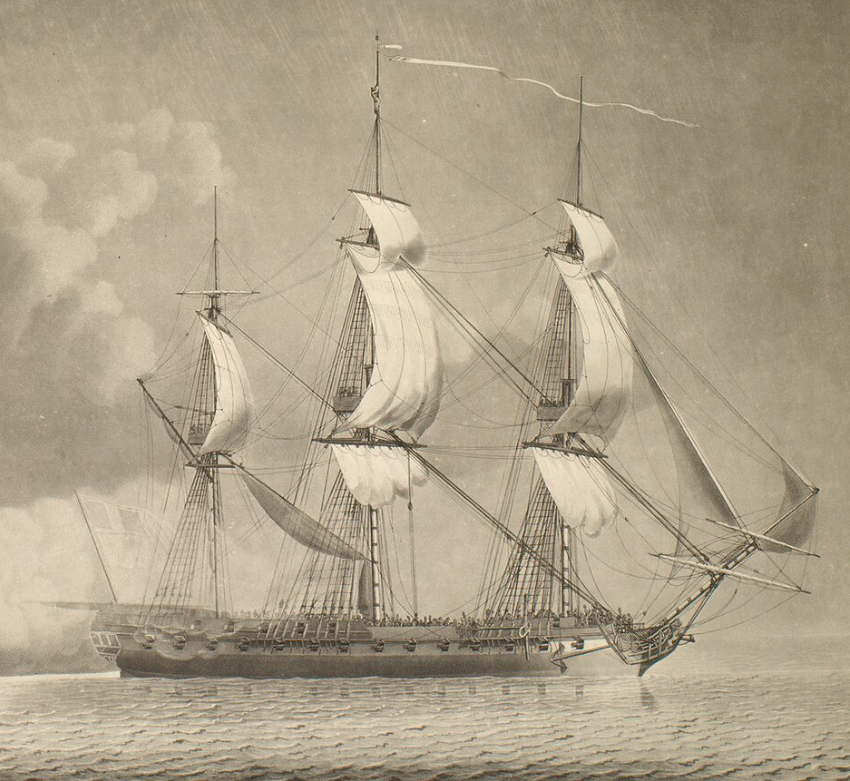
But it was towards China that one had to go. Dubois-Violette then urged Dobrée to build a great ocean-going vessel specially intended for the Far East. Launched in 1818 in the presence of the Duke of Angoulême (son of Charles X), the Fils de France left Nantes on 4 June 1818 bound for Canton, carrying 850 tuns of wines, spirits, iron, cast iron, ropes and cables. Dubois-Violette was on the voyage, again as supercargo. The round trip lasted a year to the day. The return cargo — tea, cinnamon, Chinese fabrics bought at Manila and Canton — was resold at Nantes with a profit of 42%, but the net gain remained modest.
The Fils de France was sent a second time to Canton, then to Batavia and Réunion. Between 1820 and 1829, Dubois-Violette directed the operations of his ship from Briord. The following voyages were more catastrophic. The last three voyages (1824-1829) had to be financed by a loan of 200,000 francs on the land of Briord itself. On 1 August 1829, the Fils de France was sold and broken up at Paimbœuf. The Dubois-Violette trading house disappeared from the list of Nantes shipowners.
Innovative experiments at Briord

Withdrawn to Briord from 1830, Dubois-Violette had the last medieval outbuildings of the château demolished — vestiges of the manor of Pierre Landais — and continued the construction of a set of service buildings: these are the ones that make up the "village of Briord" today, which would be completed some years later by Louis Pantin de la Guère. At Briord, he did not remain idle. He set up a nursery where he planted exotic trees; a catalogue of the nurseryman Noisette (1825) and a work by Mauny de Mornay (1842) mention oriental plane trees (attested at Briord in 1826) and, in all likelihood, peach and orange trees of Chinese origin called "Dubois-Violette". History also credits Dubois-Violette with having imported to Briord the very first mandarin plants from China (hence its name...). The climate, too harsh, did not allow the shrub to develop, and Dubois-Violette had his surviving plants sent to Malta. It seems it was from that island that they gradually returned towards the south of Europe a little later.
In November 1828, a commission of the Société académique de la Loire-Inférieure visited Briord and presented to its members the innovations it had observed there. On 56 hectares of arable land, Dubois-Violette had established "nurseries of the finest growth and greatest freshness, containing no fewer than 150,000 specimens", a livestock of 80 head of cattle, as many pigs of pure or crossed breeds — in fact Chinese pigs which the secretary of the Société académique would call in 1838 "of a hideous and repellent appearance" but which, crossed with local breeds, gave good results. Above all, 10 hectares of artificial meadows (clover) served to feed the livestock. The year's harvests: 10 hectares of sugar beet and field beet; 10.5 hectares of potatoes; 2 hectares of cattle cabbage; 0.5 hectare of swede turnips; 0.75 hectare of onions. Dubois-Violette had received in 1818 a premium of 100 francs for having harvested 580 barrels of potatoes.
Eight years after Joseph Colin had created in Nantes the first food cannery, Dubois-Violette set up at Briord a cannery intended for feeding crews at sea. Juliennes, vegetables, butter, milk and fruit in jars were shipped at Paimbœuf. It was a pioneering initiative: food canning was still a nascent industry. The Nantes archives preserve a sale price list of these preserves.
Bankruptcy and sale (1833)
Yet success was not forthcoming. The precise reasons for this failure remain obscure — the sources consulted do not allow them to be clearly established. Once again it was bankruptcy. On 4 November 1833, Dubois-Violette sold the estate and its 175.5 hectares to Louis Pantin de La Guère, husband of Marie-Zénobie Jaillard de La Maronnière, for the sum of 500,000 francs. But he reserved for himself "all the movable objects and all the livestock". The nurseries were not part of the sale, "with the exception of a sufficient assortment for the use of the land".
Two months earlier, on 16 September 1833, Dubois-Violette had married Mélanie Laroche Lucas — his companion since the early 1820s, the one who had nursed him at Briord during his first bouts of malaria in August 1821. The witness to the marriage was Thomas Dobrée the younger. The couple left Briord for the nearby château of Grandville, where they were welcomed by their former neighbour, the deputy Aristide Locquet de Grandville.
The gambling episode
It was at Grandville, one evening in 1836, that the most colourful episode of Dubois-Violette's whole life took place — an episode reported by family tradition. Aristide Locquet de Grandville, an inveterate gambler like Dubois-Violette, lost at play against his host. At the end of his resources, he came to stake his estate. Fortune, which had long abandoned Dubois-Violette, then gave him a wink: he won Grandville — the château built six years earlier by the architects Blon and Amouroux — the métairies and the lands.
Some gamblers would have pressed their advantage. Dubois-Violette did not. With panache, he gave up his winnings to the man who had taken him in during his misfortune. But he required of Grandville the construction of a house that would serve as his dwelling, precisely halfway between Grandville and Briord. A gambling debt is a debt of honour; Grandville complied and had built at La Lucerie a fine house with a park and an English garden, completed by the métairies of La Lucerie and La Métairie Verte. Dubois-Violette settled there in 1843 with his wife, his great-niece Sophie O'Neill, and a dozen servants.
In 1839, this same Aristide Locquet de Grandville, having become mayor, issued a decree forbidding games of chance within the commune...
Death at La Lucerie
On 7 July 1856, at his house of La Lucerie, Jean-Anne-Thomas Dubois-Violette died at the age of 79. He left his widow 2,400 francs of furniture, 12,000 francs of matrimonial claims, and 3,600 francs representing the six seven-parts of an old ship named the Eugène et Pauline. Was he still dreaming of China?
Mélanie Laroche Lucas remained at La Lucerie until her death, on 6 September 1880. The house of La Lucerie would be demolished in 1900 by the Count of Rochefort (heir of Grandville), erasing the memory of the famous evening. There remains today, at La Lucerie, only an ironwork well, the walls of the kitchen garden and the vestiges of the English garden.
Briord and innovation
In the long history of Briord, Jean-Anne-Thomas Dubois-Violette is neither the most famous figure nor the most spectacular. He has neither the gravity of Pierre Landais nor the panache of Joseph Charette nor the industrial dimension of Voruz. But he embodies something singular in the history of the estate: the first attempt to turn Briord into a laboratory of experimentation — agricultural (Chinese pigs, sugar beet, potatoes worked with the plough, an exotic nursery) and industrial (a pioneering cannery). This vein of innovation, far more than Joseph Charette's administrative rigour or the Voruz fortune, marks Briord with its imprint for the first half of the nineteenth century.
In terms of buildings, it is to Dubois-Violette that we owe the demolition of the last vestiges of Pierre Landais's medieval manor — part of the outbuildings — and the construction of several buildings of the village. In other words: it was he who definitively closed, in 1830, the chapter of the fifteenth century begun three hundred and sixty years earlier with Landais, and opened that of contemporary Briord. His time at Briord, though short and difficult, is therefore not a mere interlude between Charette and Pantin de La Guère: it is an architectural and cultural stratum that remains visible today in the courtyard of the village.