The hunting room located on the half-basement level of the château of Briord is truly magnificent. Its vaulted ceiling, its neo-Gothic atmosphere and its animal frieze of more than 20 metres make it a pictorial treasure of the 19th century.
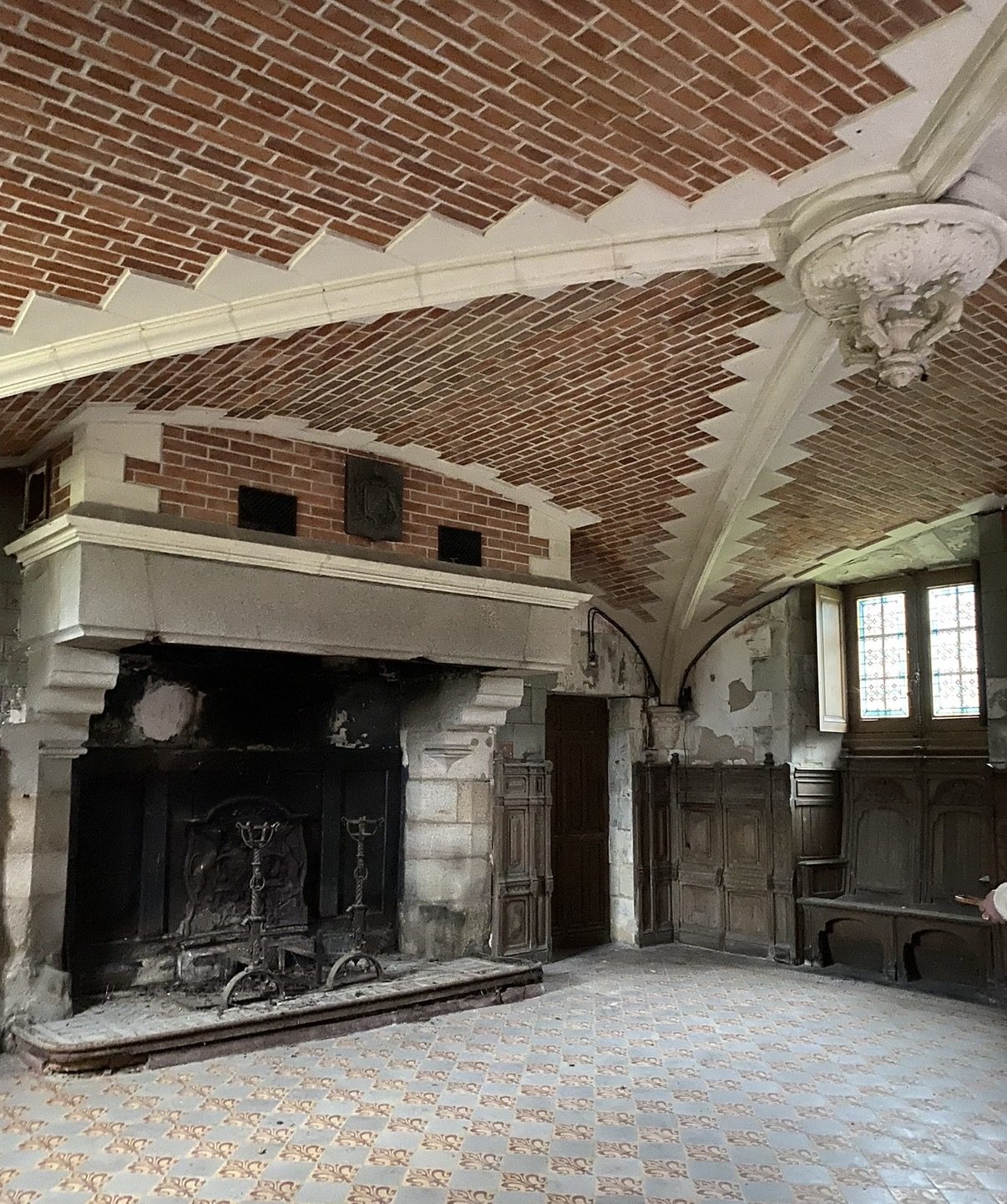
The hunting room located on the half-basement level is truly magnificent. The vaulted ceiling, the 4 corner arches that join towards a sculpted stone keystone create a unique atmosphere. The neo-Gothic ambience, very much in fashion in the second half of the 19th century, is owed to Jean-Baptiste Étienne.
The magnificent frieze painted around the entire perimeter of the hunting room was made at the request of Jean-Baptiste Étienne by a Nantes painter at the very beginning of the 20th century. Made directly on the walls, this frieze of more than 20 linear metres of animal and rural scenes underlines the curves of the vault and frames the straight lines of the custom-made oak furniture.
The fox watches the heron that watches the frog that watches the butterfly that watches... You could stay for hours looking at every detail of an animal frieze straight out of the fables of Florian or those of La Fontaine.
Did you know that before being this very beautiful hunting room, before the Revolution, it was the kitchen of the château, at the time when the lord Joseph Charette de Briord had it built, in 1770?
Jean-Baptiste Étienne, at the end of the 19th century and up until the interwar period, was considered one of the greatest huntsmen of France. His pack of 70 Vendée mongrel hounds was recognised as the most effective of the Pays de Retz. He hunted with hounds — stag and boar — mainly in the forest of Le Gâvre. To reach it, men, dogs and horses crossed the Loire in a deafening din, taking the ferry at Le Pellerin.