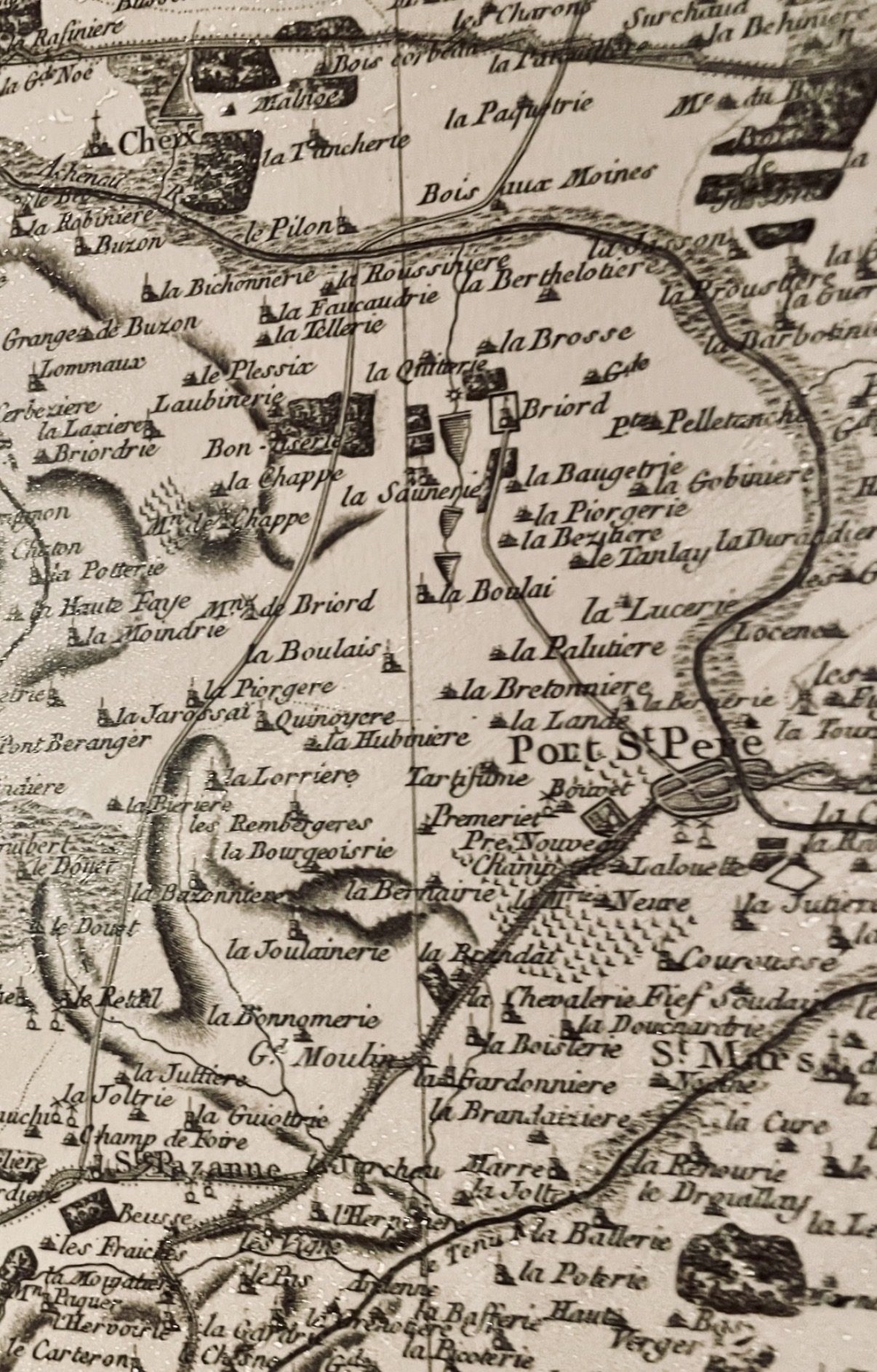
In the declaration of 1478, Pierre Landais lists six métairies at Briord. Under the Charette in the eighteenth century, La Berthelotière, La Brosse, La Quetterie and La Bojetterie are named individually. At the revolutionary sales of 1796–1798, La Moinerie, La Pullière, La Bézitière and La Quétrie were dispersed. The sale plan of 1884 drawn up for Voruz lists eleven holdings precisely: Pullière, Gobinière, Bertaudière, Brosse, Cour de Briord, Bézitière, Bogetterie, Bruyères noires, Landes, Quetterie, together with the château's home farm, amounting to 250 hectares 96 ares 71 centiares. Five centuries of seigneurial farming, documented by the archives.
The economic frame of the estate
A lordship of the Ancien Régime did not live on its château but on its métairies — farms held on a sharecropping lease, the tenant paying his rent in a share of the harvest. At Briord this system of husbandry was the economic frame of the estate for more than five centuries, from the medieval declarations down to the years preceding the death of Jean-Baptiste Étienne in 1949. Their names, their number, their extent, their revenues: all this is documented step by step in the archives, from the first mention in the declaration rendered by Pierre Landais to Duke Francis II in 1478, to the detailed plan drawn up in 1884 for the sale to Jean-Simon Voruz. These documents make it possible, better than for any other aspect of the estate, to follow the slow evolution of an ancient farming system.
The six medieval métairies
The declaration of 1478 is the first precise document. For his châtellenie of Briord, Pierre Landais there declares an annual yield of 133 livres from quit-rents, from the working of 120 journaux of woodland, from meadows, ponds and feudal dues, to which are added the produce of 300 hommées of vines, the six métairies, and the fisheries. The names of these six holdings have not come down to us in that document — medieval declarations favour the statement of rents over lists of names.
Even before Landais, an earlier mention documents the system: around 1380, under Sevestre de Rezay, the heirs of this first seigneurial family had to pay the redemption due on the "corn of the métairie of Briort of the August of thirteen hundred and six", leased to Jehan Le Charpentier, métayer, who delivered his corn to the duke's granary at Machecoul. This is the first mention of a Briord tenant by name — and it shows that the leasing system already existed in the fourteenth century. The corn harvested came to six septiers by the measure of Machecoul, worth nine septiers by that of Saint-Philibert — a precise indication of how local measures stood in relation to one another at the close of the Middle Ages.
The seventeenth-century declarations
In 1657, under the L'Espinay, a substantial head of stock is recorded across the seven métairies depending on Briord: 10 pairs of plough oxen, 60 cows, 17 calves, 13 bulls, 14 heifers, 16 young cattle of both sexes, and 330 ewes and lambs. The lordship had therefore gained one further holding since Landais's day.
In 1678, a declaration submitted for the reform of the royal domain sets out the territorial extent of the châtellenie and the rents it drew. The métairies are not all named, but the declarations speak of rents due on various places: La Frogerie, La Piorgère, La Boullais, La Bézitière, Les Ménarderies, La Métairie-Neuve, La Pallutière, Les Landes — names of which some denote holdings attached to farms of the estate.
The golden age under the Charette (eighteenth century)
It was under the Charette that the châtellenie reached its fullest development. At the death of Jean Charette in 1754, his fortune was valued at 180,000 livres; the châtellenie held "a great number of income-bearing métairies", of which the archives name:
These four holdings are identified by name in the estate accounts. To them were added bordages — smallholdings — along with windmills and a fulling mill. In the middle of the eighteenth century the stock comprised 7 pairs of plough oxen, 7 mares, 2 foals, 55 milk cows, 1 calf, 8 bulls and 191 sheep, valued at 2,544 livres.
Joseph Charette, who inherited the lordship in 1746 at barely twenty, was among the few noblemen to keep precise accounts himself. His "account book of the revenues of the noble house of Briord", opened in 1746 and kept until 1788, preserved in the Departmental Archives among the Bizeul papers, is an exceptional document. In it one reads the steady rise of the estate's income: 5,826 livres in 1747, 23,310 livres in 1782. The yield of the métairies doubled over that period, from 2,000 to 4,000 livres, but it was the sale of produce — wheat, rye, buckwheat, green peas, oats, cattle, young pigs, broom, calves, sheep, wool, chestnut timber — that made up the greater part of the revenue.
Joseph Charette, manager and humanist
The pages of the account book reveal a rigorous but even-handed manager. In a memorandum of 16 May 1769, Joseph Charette advises never to draw up leases before a notary, and never to depart from the acreages given in the old declarations. But he adds a humane consideration, rare for the time, on the level of the rents:
"I believe they must not be touched at all, and that they stand at their just price. Were they too dear, none but poor men would come forward; one cannot too strongly urge the advantage of keeping these métairies in good repute, and of having none but men of means in them… I have brought the land to the highest point of honest value at which humanity requires that the ploughmen should live, and the owner not be the dupe."
This sought-for balance between the owner's interest and the tenant's subsistence is characteristic of an aristocrat of the Enlightenment, a reader of Rousseau and Montesquieu whose works he kept in his library. For day-to-day management Joseph Charette relied on his fiscal procurator René Souchu, engaged in 1779 as steward at Briord — the same Souchu who would become grimly notorious in 1793 for his part in the Machecoul massacres.
The revolutionary sales (1796–1798)
After the death of Joseph Charette on 17 October 1792, the estate was sequestered on 20 June 1793 as property of the second category, having belonged to a former nobleman. But the sale to the Nation was not to be complete: Joseph's daughter, Louise du Cambout de Coislin, through an ingenious arrangement involving nominees and tenant farmers, had the parts of the estate bought back one by one, to be sold on to Jean-Anne Duboisviolette in 1800. The revolutionary sales allow us to know, through the deeds of adjudication, which métairies then stood as separate holdings:
Most of the names that would last until the end of the nineteenth century appear in these deeds: Moinerie, Bojetterie, Pullière, Berthelotière, Brosse, Bézitière, Quetterie, together with the lands of the Briord mill.
The estate under Duboisviolette (1800–1833)

After the estate had been reassembled by Louise du Cambout de Coislin and passed to Jean-Anne Duboisviolette, the landed property of Briord comprised, according to the inventory of 1804: the main house, the enclosure of 52 hectares, 6 métairies of 220 hectares and 14 smallholdings of 38 hectares — some 310 hectares in all. The names of the six farms are not given in that document, but they were in all likelihood, for the most part, those already named in the revolutionary sales.
Under the Duboisviolette the métairies became the setting for agricultural experiment. In November 1828 a commission of the Académie de la Loire-Inférieure visited Briord and described the master's trials: on 56 hectares of arable, Jean-Anne-Thomas Duboisviolette had established a nursery of 150,000 plants — including oriental plane trees recorded at Briord in 1826, and peach and orange trees of Chinese origin — a herd of 80 cattle and as many Chinese pigs used for crossing with local breeds, and novel crops: sugar beet, potatoes (Duboisviolette had received a prize of 100 francs in 1818 for a crop of 580 barrels), fodder cabbage, swedes, and onions sown by the plough.
The sale of 1884: the precise map
When Countess Pelet de Lautrec sold the estate to Jean-Simon Voruz, a precise plan was drawn up for the sale. The document prepared around 1884 by the notary Jaguelin of Vue lists the exact components of the property offered. It is the most detailed mapping we possess for Briord: total: 250 hectares 96 ares 71 centiares.
This plan is a heritage document of the first order. It shows that the configuration settled in the eighteenth century — Pullière, Brosse, Berthelotière, Bézitière, Bojetterie (Bogetterie), Quetterie, Moinerie — was still in the main that of the estate at the close of the nineteenth, though with adjustments: La Gobinière, La Cour de Briord and Les Bruyères noires appear, while other holdings — La Moinerie in particular, sold separately at the revolutionary sales — had been detached.
Voruz, Étienne and the end of a system
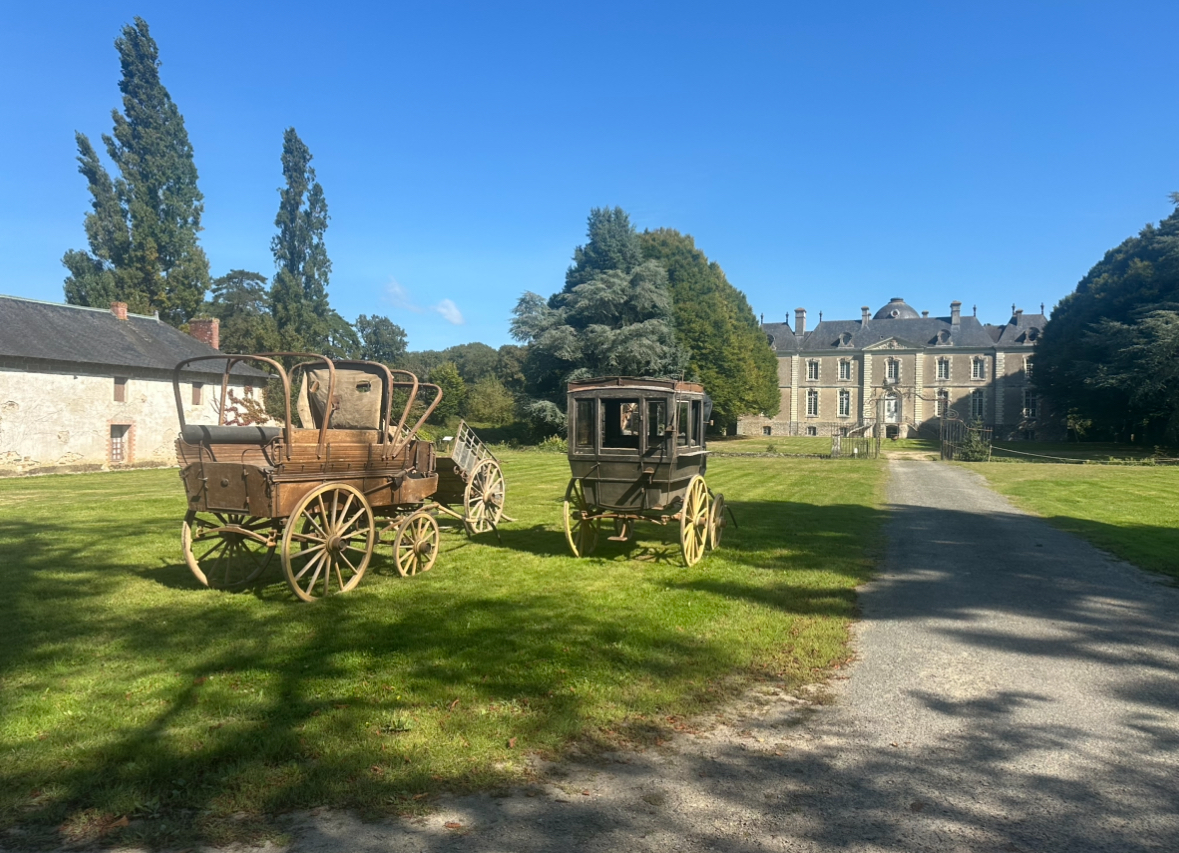
After 1885, Jean-Simon Voruz and then his grandson Jean-Baptiste Étienne kept the structure of métairies. The names of the stewards and gamekeepers of the period appear in the archives: Jean-Joseph You in 1908, Ollivier in 1934, Albert Menant in 1939. The steward Jean-Baptiste Bauvineau is mentioned in 1910, in a matter concerning 32 grafted Muscadet vines that had been cut — a sign that the post-phylloxera replanting of the vineyard was well under way under Jean-Baptiste Étienne.
Through the sixty-four years of the Voruz-Étienne era, the métairies of Briord lived to the rhythm of the first half of the twentieth century. The First World War took away the men and the horses; the inter-war years brought uneven technical modernisation; the Occupation imposed requisitions and restrictions. Most of the half-share leases that had marked the Ancien Régime gave way little by little to money rents.
When Jean-Baptiste Étienne died at Nantes, in the rue Linné, on 22 October 1949, the estate he left still comprised its métairies and smallholdings — names that would be taken up again in the inventory of his succession.
Place names and memory
The names of the Briord métairies — Pullière, Gobinière, Bertaudière, Brosse, Cour de Briord, Bézitière, Bogetterie, Bruyères noires, Landes, Quetterie, Moinerie — now belong to the place-name heritage of the Pays de Retz. They appear in the Napoleonic land register of 1830–1837 (series 3 P at the Departmental Archives of Loire-Atlantique) and in the successive notarial deeds.
Some names speak of geography (Bruyères noires, Landes), others of distant founders (Berthelotière), others again of old religious institutions (Moinerie, which suggests a monastic dependency).
Each of these names carries five centuries of farming history. Beneath their walls, in their byres and their meadows, followed one another the families of tenants whose names — Davié, Guillon, Favreau, Pierre Rousseau, Bichon, Guion, Le Charpentier — have reached us through the account books and the declarations. Those families, who fed the château, were as much as the lords themselves the actors of Briord's long duration.
Sources consulted
Departmental Archives of Loire-Atlantique: the Briord chartulary (E 351–375); declarations of Pierre Landais to Duke Francis II, 1469 and 1478; declaration of the reform of 1678 (B 1907–1908); declarations of the parish of Port-Saint-Père (B 1853); 2 J 52 (Bizeul papers, account book of Joseph Charette, 1746–1788); 1 Q 149 (sale of Briord, 1798); 1 Q 505 (inventory of 1792); 4 E 19/125 (plan of the estate, around 1884); 4 E 12/550 (Lallié notarial records, sale of 1833); 4 E 2/606 (Defrondat notarial records, agreement of 17 July 1800); 3 P 137 (Napoleonic land register of Port-Saint-Père). Municipal Archives of Nantes, Dobrée papers (2 A 177): Duboisviolette-Dobrée correspondence, plan of the nursery, price lists for preserves. Académie de la Loire-Inférieure, report of the visit to Briord, November 1828. Auguste Laurant, Historiographie de la châtellenie de Briord, 1886 (manuscript held at Briord). On the feudal history of the Pays de Retz: Société d'histoire du pays de Retz, Revue, various issues. On the vocabulary of the sharecropping lease: Marcel Garaud, La Révolution et l'égalité civile, Sirey, 1953; Georges Lefebvre, Études orléanaises.