It was from him that Martin de Rezay obtained, in 1437, the elevation of Briord into a seigneury of high justice. John V reigned for forty years over a prosperous and almost independent Brittany.
He never owned Briord. Yet without him, Briord would never have become a seigneury of high justice. It is on this account that Duke John V enters the history of the estate.
A long reign
John V, known as "the Wise" or "the Good", born in 1389, reigned over the Duchy of Brittany from 1399 until his death in 1442 — more than forty years. His reign, one of the longest in Breton history, was that of an almost sovereign principality, poised between the Kingdom of France and England, in the midst of the Hundred Years' War.
The balancing act
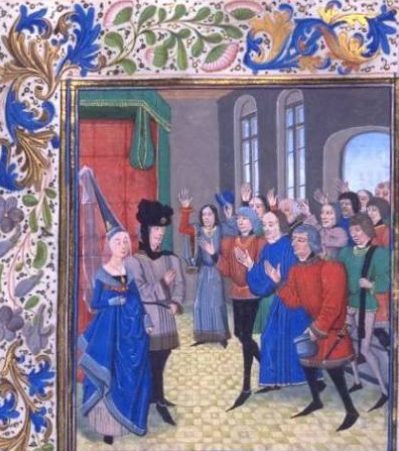
The whole of John V's policy lay in a delicate balance: to handle both France and England without submitting to either. He succeeded well enough to keep Brittany at peace and prosperous while the rest of the kingdom tore itself apart. Nantes trade flourished, the towns grew rich, and the ducal court shone.
The lord who made Briord
It was in this context that, in 1437, the duke granted Martin de Rezay the elevation of his Land of Briord into a seigneury of high justice, with the right of a three-post gallows. By this act, John V raised a land of the Pays de Retz to the rank of the great châtellenies.
This gesture, crucial for a duke who granted few favours and privileges, was decisive for Briord: it fixed the status of the estate for the centuries to come.
The memory of a duke
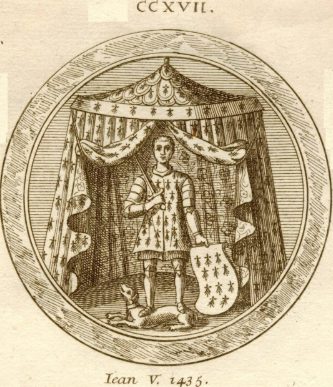
John V died in 1442 at Nantes. He left behind a powerful duchy, which his successors — down to Francis II and Anne of Brittany — would not always know how to preserve. But for the Land of Briord, his name remains bound to the founding act of 1437.
It was by the will of John V that the Land of Briord was raised to the rank of a châtellenie of High Justice. This exceptional privilege made Martin de Rezay one of the most powerful lords of the duchy.
This privilege, strictly attached to the Land of Briord, would be handed down from master to master of Briord until the night of 4 to 5 August 1789 and the abolition of privileges.