Emperor of the French from 1852 to 1870, Napoleon III reigned over France during the very years when Count Pelet de Lautrec was master of Briord. His Italian policy led the lord as far as the siege of Gaeta.
"The Empire means peace."
Louis-Napoléon Bonaparte, Bordeaux speech, 9 October 1852
A Bonaparte under the Second Empire, a royalist at Briord
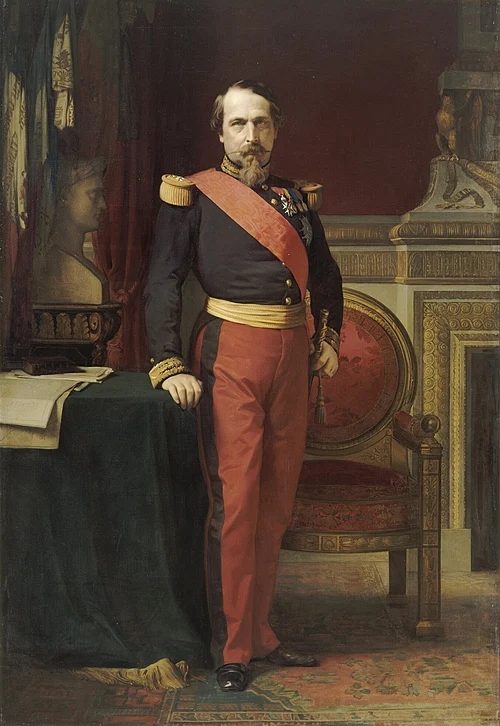
Of all the sovereigns who reigned over France while the Land of Briord was inhabited, Napoleon III is the one whose reign coincides almost exactly with the years of the most novelistic of the estate's masters, Count Michel-Adolphe Pelet de Lautrec. While the Emperor governed France from 1852 to 1870, the lord of Briord — an aristocrat and a royalist — led at Port-Saint-Père a life several episodes of which cross directly with imperial policy. To retrace the life of Napoleon III is therefore to illuminate the national background of an entire chapter in the history of Briord.
The heir to a name
Charles-Louis-Napoléon Bonaparte was born in Paris on 20 April 1808, at the Tuileries Palace. He was the third son of Louis Bonaparte, King of Holland and brother of Emperor Napoleon I, and of Hortense de Beauharnais, daughter of Empress Joséphine. After the fall of the First Empire in 1815, the child followed his mother into exile, in Bavaria and then in Switzerland, where he received a careful education. The death of the Duke of Reichstadt — the son of Napoleon I — in 1832 made him the principal pretender of the House of Bonaparte.
Convinced of his destiny, he twice attempted to overthrow the July Monarchy: at Strasbourg in 1836, then at Boulogne-sur-Mer in 1840. These attempts failed. The second earned him imprisonment at the fort of Ham, in the Somme, where he remained until his escape in 1846. It was during this captivity that he wrote The Extinction of Pauperism, a work in which his social preoccupations took shape.
From prince-president to Emperor
The revolution of February 1848, which overthrew King Louis-Philippe and proclaimed the Second Republic, at last opened the path to power. Returned to France, Louis-Napoléon was elected to the Assembly, then stood for the presidential election. On 10 December 1848, he was elected the first President of the Republic by universal male suffrage, with nearly 74% of the vote, for a single four-year term.
It was in this capacity as prince-president that he came to Nantes on 30 July 1849. Arriving by the Loire, he was welcomed by a twenty-one-gun salute, reviewed the national guard and the garrison troops at the Prairie de Mauves, then visited the port and the city. Thus the future Napoleon III appeared, as early as 1849, at the gates of the Pays de Retz, only a few leagues from Briord.
The Constitution forbidding him to stand again, he seized power by the coup d'état of 2 December 1851, dissolved the Assembly and had his act ratified by plebiscite. A year later, a new plebiscite restored the imperial dignity: on 2 December 1852, the prince-president became Emperor Napoleon III. In January 1853, he married the Spanish aristocrat Eugénie de Montijo; their only son, Louis-Napoléon, known as the Prince Imperial, was born in 1856.
The Second Empire, the Briord years
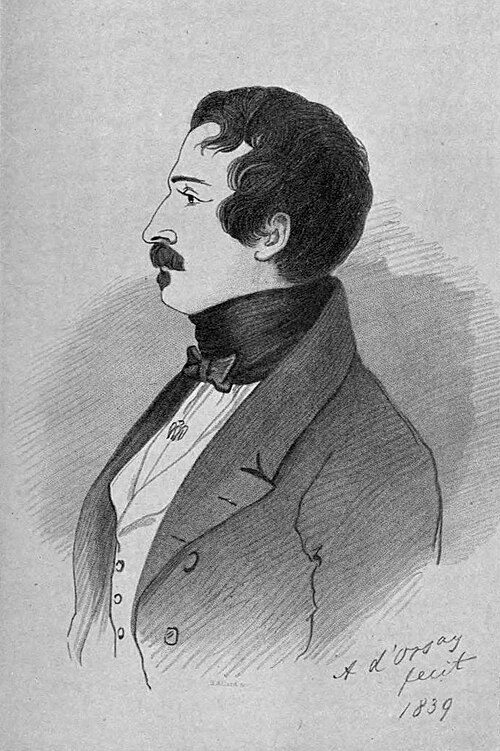
The reign of Napoleon III coincides almost term for term with the presence at Briord of Count Pelet de Lautrec, who became master of the estate through his marriage, on 17 June 1850, to Mathilde Pantin de La Guère. These two decades were, for France, those of a remarkable industrial surge: the development of the railway, the great works of Baron Haussmann in Paris, the modernisation of agriculture. The Pays de Retz took part in this movement. It was under the Second Empire, in 1865, that the agricultural show of the combined cantons of Bourgneuf and Le Pellerin was created, and the estate of Briord held its rank there: at the regional competition of Nantes in 1855, Count Pelet de Lautrec was awarded a prize for his oxen; in 1866, he received a gold medal for his agricultural produce. The agronomic prosperity of Briord thus fitted fully within the economic momentum of the Empire.
Magenta, Solferino and the Italian question
In foreign policy, Napoleon III sought to play a leading role. After the Crimean War (1854-1856), he made himself the protector of Italian unity. In July 1858, he met secretly at Plombières with Camillo Cavour, minister of the Kingdom of Piedmont-Sardinia, and sealed an alliance against Austria. The Italian campaign of 1859 was marked by the Franco-Piedmontese victories of Magenta and Solferino; in 1860, Savoy and the county of Nice were attached to France.
This Italian policy would join, in the most direct manner, the history of Briord. For the support given by Napoleon III to the Italian national movement precipitated the fall of the Kingdom of the Two Sicilies. In May 1860, Garibaldi landed in Sicily; in September, the young king Francis II abandoned Naples and entrenched himself in the citadel of Gaeta. It was there that the lord of Briord entered the scene.
Gaeta: the master of Briord and the Emperor's policy
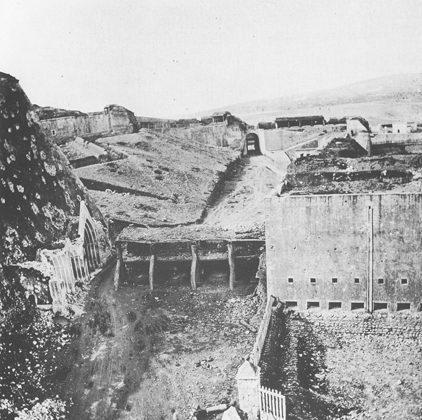
The siege of Gaeta, from 5 November 1860 to 13 February 1861, was the last stand of Francis II. Moved by the courage of the young sovereign, French legitimists and former papal zouaves spontaneously placed themselves at his service. Among them, Count Pelet de Lautrec, master of Briord, went to fight for the King of Naples and was received by Pope Pius IX.
Yet France's position was ambiguous. For several months, Napoleon III's French fleet lay before Gaeta and prevented the Sardinian navy from blockading the place from the sea. But on 19 January 1861, following a secret agreement between Napoleon III and Cavour, the French ships withdrew: deprived of this protection, the citadel fell a few weeks later. Thus the royalist master of Briord had fought in a cause that the Emperor's diplomacy, after protecting it for a time, ended by abandoning. The history of the estate of Briord bears, through its lord, the trace of this great European game led by Napoleon III.
Grandeur and decline
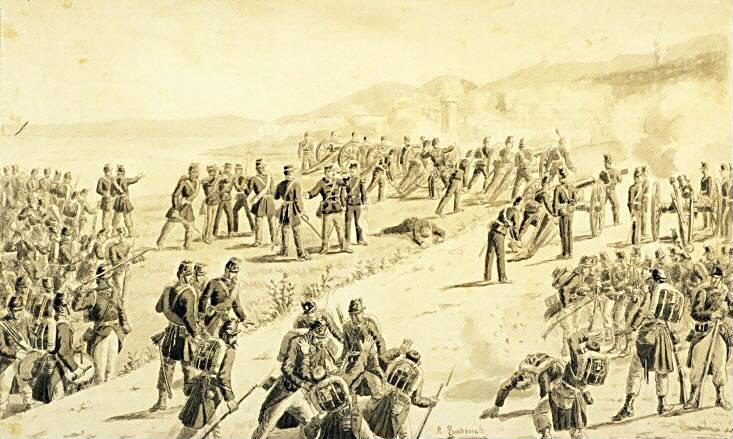
The final years of the reign were darker. The Mexican expedition (1861-1867), undertaken to install there a regime favourable to France, ended in a resounding failure. In Europe, the rise of Bismarck's Prussia caused alarm. At home, the ailing Emperor softened his authoritarian regime and granted liberal reforms at the end of the 1860s.
The break came in 1870. Drawn into a war against Prussia, the Empire collapsed militarily. On 2 September 1870, Napoleon III capitulated at Sedan and was taken prisoner. As soon as the defeat became known, the Republic was proclaimed in Paris on 4 September. Freed in 1871, the former emperor reached England and settled at Chislehurst, in Kent, where he died on 9 January 1873, at the age of sixty-four.
A memory, a mirror of Briord
Posterity long reduced Napoleon III to the disaster of Sedan. Recent historiography acknowledges more fully the complexity of his reign, between authoritarianism and modernisation. For Briord, the Second Empire remains a flourishing period: the one in which the estate, under the guidance of a royalist lord whom everything nonetheless set against the regime, knew agricultural prosperity, was adorned with a chapel enlarged and blessed in 1853, and saw its master bear arms as far as the ramparts of Gaeta. Napoleon III never set foot on the Land of Briord; but his reign, by a thousand threads, wove its background.