In 1770, Joseph Charette de Briord, a gentleman of forty-seven, had built above the meadows of the Acheneau the château we know today.
A man in his maturity
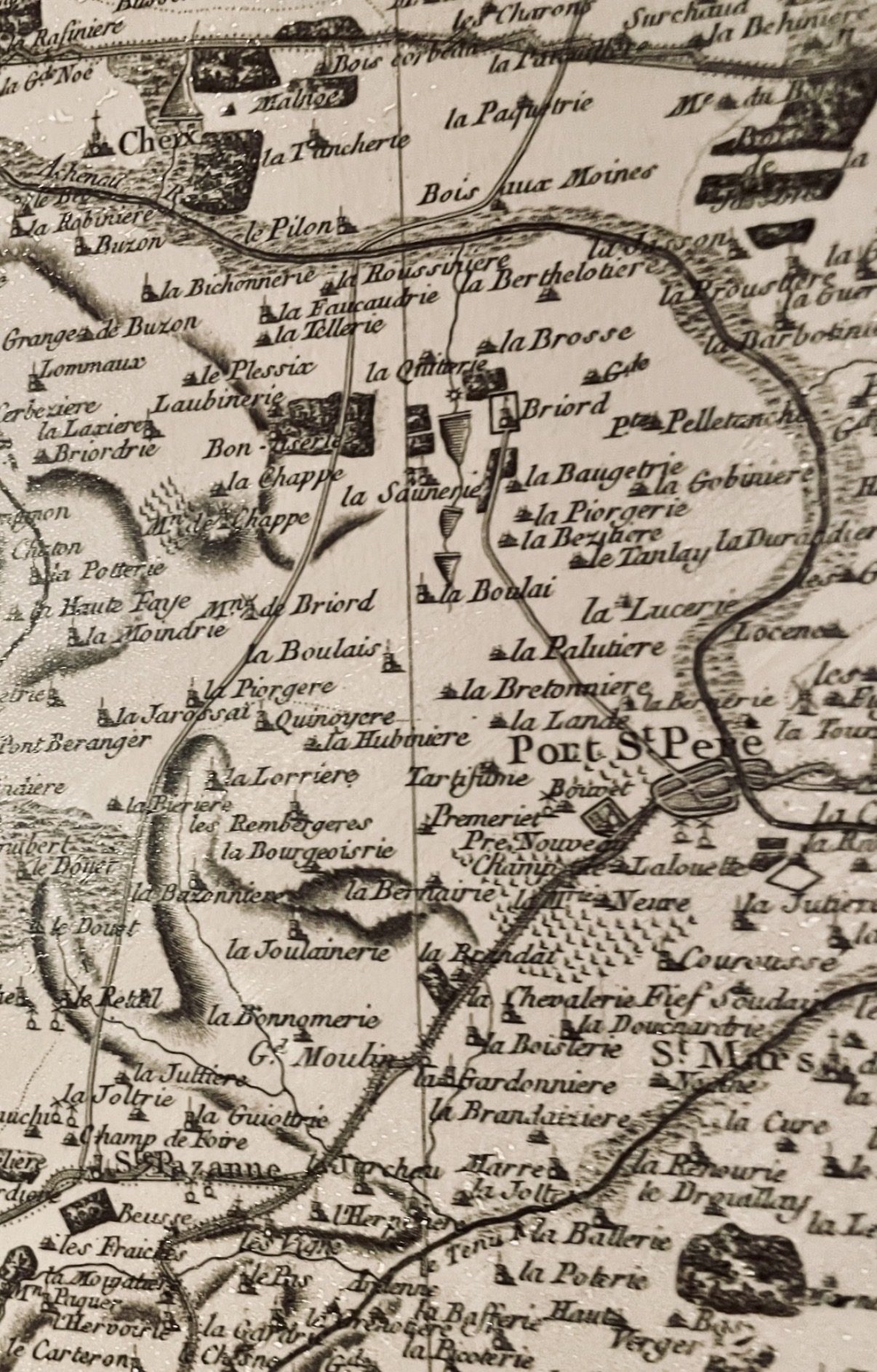
In 1770, Joseph de Charette de Briord was forty-seven. Born in 1723, son of Jean de Charette, lord of La Botinière at Vallet, and of Françoise de L'Espinay, heiress of the Briord estate, he belonged to an old Nantes lineage. The Charette were not lords of ancient land: they were parliamentarians, magistrates, mayors — seven of them wore the sash of Nantes — who held across the Nantes country a network of estates whose names still echo in the archives: La Colinière, Le Bois-Briant, La Chauvelière, La Contrie, La Gascherie. The Pays de Retz at first remained foreign to them: it was not until the eighteenth century that the house acquired Boisfoucault, Le Moulin-Henriet, Le Bois-Chevalier. Briord, through marriage, was one of these late acquisitions, like a promise the Charette meant to keep in that countryside between the Loire and the Vendée.
In 1747, at twenty-four, Joseph married Michelle Portier de Lantimo, daughter of a Nantes merchant. Their union lasted only four years: Michelle died in 1751, leaving him but one daughter, Louise, who would later carry the future of the house.
Joseph would not remarry.
In 1754, on his father's death, he inherited the estate at thirty-one. His mother, Françoise de L'Espinay, would outlive her husband until 1773. For sixteen years, Joseph managed Briord without brilliance but without weakness: he knew his peasants, consolidated the renowned vineyard of Briord, and took the measure of the land that was his. When he decided, shortly before his fiftieth year, to build a new château, it was not on impulse — it was a long-considered decision, borne by a man who had had time to know what he wanted.
The year of all possibilities
1770 was a paradoxical year. Louis XV, ageing, had reigned for more than half a century over a prosperous and contested kingdom. In May, the Dauphin — the future Louis XVI — married a fourteen-year-old Austrian archduchess named Marie-Antoinette. Voltaire thundered from Ferney. Rousseau was finishing his Confessions. The Encyclopaedists were read in the salons, Rameau and Gluck were played in the theatres, and everywhere in France dwellings were being built that turned their backs on the pomp of the Grand Siècle to adopt a more sober, more intimate, more human elegance.
At Nantes, the times were doubly favourable. The port was the foremost in France for Atlantic trade. The shipowners' fortunes — built in part on the triangular trade and the slave trade, a dark page the regional history still bears — nourished an architectural effervescence without precedent. The Île Feydeau and its mascaron-adorned buildings were being raised, the new quays traced, town-houses with sculpted pediments erected. A merchant aristocracy was asserting itself, one that wished, like the noblesse d'épée of past centuries, to own its château in the country.
But those châteaux would no longer be the fortresses of their ancestors. They would be folies.
What was a folie in the Age of Enlightenment?
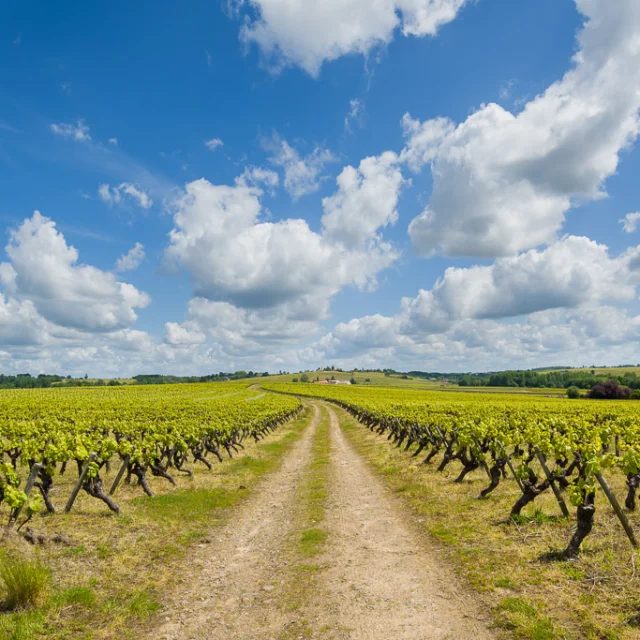
The word was not new. In the eighteenth century, the term "folie" — from the Latin folia, foliage, then by a shift of meaning the pleasure house surrounded by greenery — denoted a country retreat whose function was less to represent the social rank of its owner than to offer him, far from the miasmas of the town, a refined setting for the private pleasures of conversation, reading and walking.
The Nantes folie, however, had an identity of its own. It was neither the Bordeaux chartreuse nor the Parisian pavilion. It combined several characteristic traits. First, a rectangular and symmetrical plan, with a taller central block flanked by side pavilions. Symmetry reigned, an inheritance of French classicism, but it was tempered by freer decorative details — a balustrade, an ornate dormer, a balcony.
Next, human proportions. Where Versailles overwhelms, the Nantes folie enfolds. There was no oversized ceremonial hall nor hall of mirrors. The rooms were proportioned to daily life: a drawing room for receiving, a dining room for long gatherings, a library, a few bedrooms including the master's, sometimes a study. The scale was domestic, warm.
A carefully tended landscape, finally, completed the composition. The Nantes folie did not exist without its park. Avenues lined with lime trees, perspectives ruled straight to the horizon, meadows sloping gently down, discreet groves of native species — oaks, beeches, chestnuts. The art of the gardener counted as much as that of the architect.
Joseph's choice
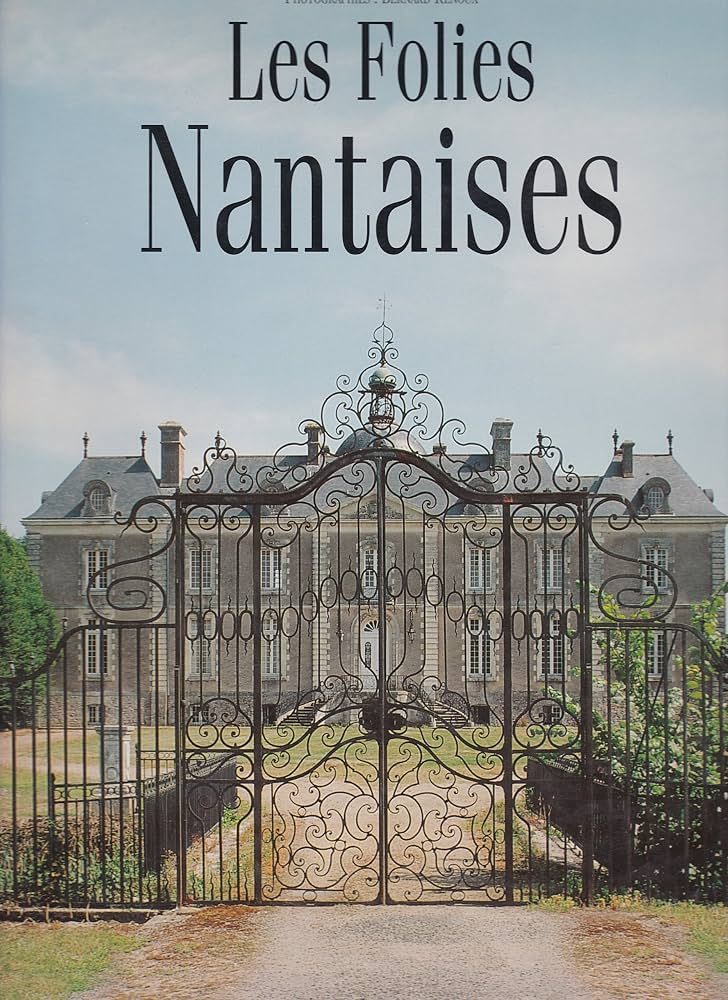
All these characteristics Joseph de Charette embraced with the resolve of a man who knew exactly what he wanted. The château he had raised from 1770 was a canonical folie, but a folie that owned its scale. The central block stretched out, the side pavilions balanced one another, and the façade, playing on pale ashlar, drew a silhouette at once firm and graceful. Deep moats surrounded the dwelling, and the great avenues traced as early as the fifteenth century by Pierre Landais, then treasurer of the Duke of Brittany, still lead the visitor towards the château today; nearby, three ponds laid out in the same period punctuate the landscape, ancient witnesses of a land long shaped by the hand of man.
Joseph did not content himself with the château. Around 1780, he had built nearby a private chapel, then dedicated to the Virgin Mary. It was only later, when the chapel was enlarged, that it was reconsecrated to Saint Germain — and it is under this name that it is known today. In 1782, Joseph bought back from the Baron of Retz two seigneuries that were added to Briord: Les Huguetières at Port-Saint-Père and Chappes at Saint-Hilaire-de-Chaléon. In 1783, the châtellenie of Briord exercised rights of high, middle and low justice over nearly a dozen parishes, from Port-Saint-Père to Sainte-Pazanne. This was the territorial apogee of the estate.
A century in suspense
When Joseph laid the first stone of his folie, he did not know that his century would not last much longer. Less than twenty years separated him from 1789. In that pivotal year, he rendered a last homage for his châtellenie: the solemn gesture by which a lord acknowledged that he held his lands of the Crown. It was one of the last acts of its kind in the Pays de Retz. A few weeks later, the Night of 4 August would abolish all seigneurial rights.
Faced with the storm, many nobles of his generation chose emigration. Joseph, for his part, remained at Briord. He left neither for Koblenz nor for England. He stayed in the house he had built, among the peasants he had known for forty years. That fidelity was surely his last silent declaration.
He died in October 1792, at sixty-nine, before the great revolt of March 1793 broke out in the Pays de Retz, before the Infernal Columns of 1794, before the ravages that would strike so many estates of the Breton Marsh.
In a sense, the man and his century died together.
In 1793, the estate was placed under sequestration and sold as a national asset. But his daughter Louise, wife of Du Cambout de Coislin, managed — through buyers acting on her behalf — patiently to reconstitute the family patrimony. She would sell it legally, in 1800, to the Nantes merchant Jean-Anne Dubois-Violette, who would prolong the adventure of Briord in his own way.
Through a series of happy circumstances — its somewhat out-of-the-way position, its access protected by the meanders of the Acheneau, and no doubt too the loyalty of the local peasants — the château itself escaped almost miraculously the revolutionary destructions that struck so many neighbouring dwellings. It still stands today, in its 1770 silhouette, just as Joseph wished it.
It is this dwelling that the Terre de Briord project now undertakes to restore, stone by stone, exactly as it was between the end of the eighteenth century and the beginning of the twentieth.
So that there may return, to these meadows of the Pays de Retz, the memory of a man, of a family, and of a world.